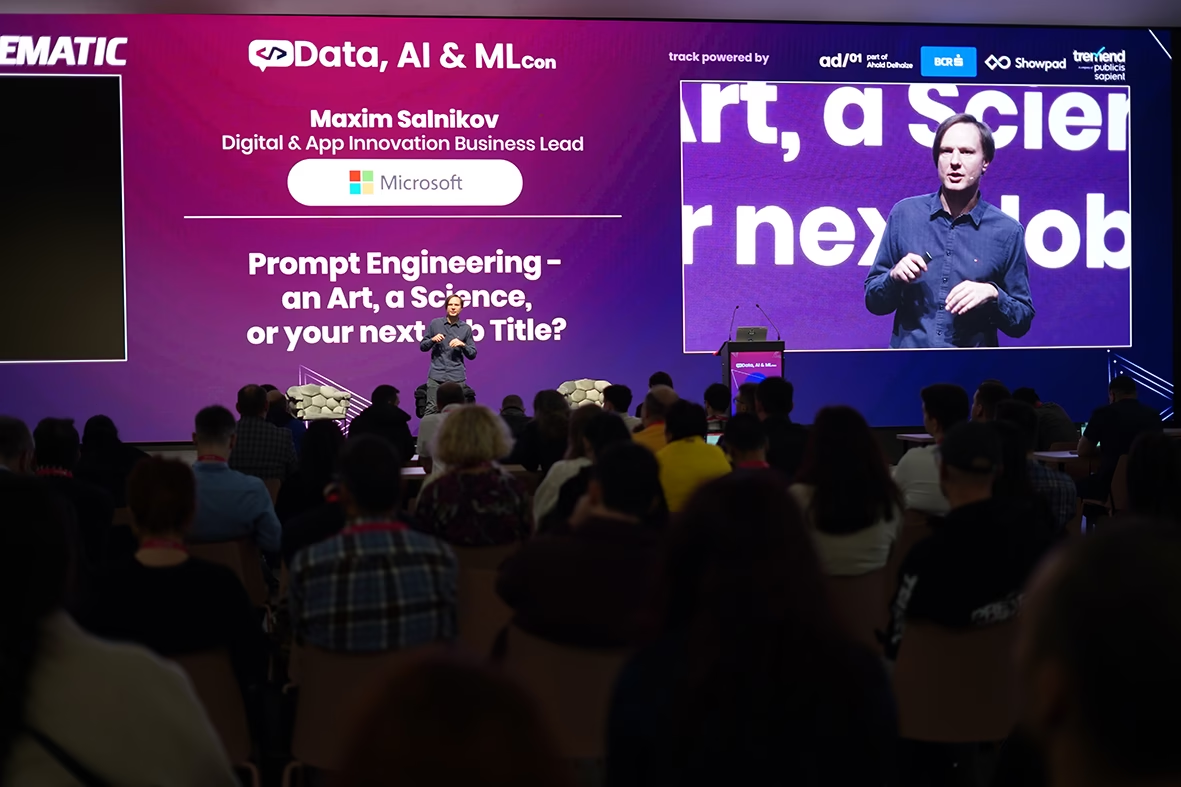
Last month, I had the pleasure of meeting Maxim Salnikov on stage at DevCon, a seasoned engineer pushing the boundaries of AI, cloud, and developer productivity. As the Digital & Application Innovation Business Lead for Microsoft Western Europe, Maxim is committed to driving AI adoption and equipping developers across ten countries with tools like GitHub Copilot.
With over 25 years of experience, Maxim has not only driven advancements in cloud solutions but also built thriving tech communities like ngVikings and Mobile Era. In this exclusive feature, we explore his journey of aligning innovation with developers’ real needs.
Maxim, as the Digital & App Innovation Business Lead for Microsoft, how do you balance driving innovation in AI applications with ensuring developer productivity across such a diverse region?
It’s all about striking a balance between inspiration and enablement. Innovation in AI is exciting, but it has to translate into tangible tools and processes for developers. I aim to create scalable strategies while personalizing support through customer & partners programs & initiatives, as well as engaging developer communities in my area. Productivity tools like GitHub Copilot are great examples of AI-driven innovation that directly impacts developer efficiency.
You work at the intersection of cloud-native technologies and AI. How do you see these fields evolving together, and what role does Microsoft play in this transformation?
Cloud-native and AI are like best friends – one enables the other to thrive. AI thrives on scalability and vast data pipelines, which the cloud delivers. On the flip side, AI is redefining how we manage, secure, and optimize cloud-native applications. At Microsoft, we’re doubling down on integrating AI into many developer tools, helping developers build smarter, scalable applications faster.
Your DevCon talk focused on Prompt Engineering as an emerging discipline. Why do you believe it’s becoming a critical skill for developers, and how can they incorporate it into their workflows?
Prompt engineering is a bit like learning the syntax of a new programming language. Generative AI models are immensely powerful but only as effective as the prompts they’re fed. Developers can start incorporating it by experimenting with AI tools like Azure AI Foundry, Prompt Flow, Prompty, refining their prompts iteratively, and embedding these techniques into everyday workflows like debugging, documentation, or code generation. It’s all about knowing how to converse effectively with AI.
How do you see tools like GitHub Copilot and advanced prompt engineering shaping the future of coding and developer productivity?
These tools are flipping the traditional coding paradigm. Instead of “writing” code, we’re moving toward “guiding” code. Developers will focus more on defining intent and less on the repetitive grunt work. Copilot already removes friction by generating boilerplate or contextually relevant code, and with prompt engineering, you can customize its behavior further to align with your style or requirements. Together, they make coding smarter, faster, and honestly, more fun.
What are the most common mistakes developers make when working with large language models like ChatGPT, and how can prompt engineering methodologies mitigate these issues?
One common mistake is assuming the model knows everything and taking its output at face value. Another is vague prompting, leading to irrelevant or imprecise answers. Prompt engineering methodologies – like being explicit in instructions, providing examples, or iterating based on responses – can help refine outputs and reduce the risk of errors. It’s about knowing the model’s strengths and weaknesses and designing your prompts accordingly.
You’ve built and managed significant developer communities like ngVikings and Mobile Era. What strategies have been most effective in fostering collaboration and innovation within these groups?
It boils down to creating safe, inclusive spaces where people feel valued and heard. Encouraging open sharing – whether it’s successes or failures – builds trust and collaboration. I also find that blending high-quality technical content with opportunities for informal networking creates a great balance. And gamification or fun challenges never hurt – it keeps the energy high and engagement up.
With over 200 speaking engagements worldwide, how do you adapt your technical sessions to inspire both seasoned developers and newcomers in the field?
Storytelling is my secret weapon. Whether I’m speaking to a room of senior architects or students, I anchor my talks with relatable scenarios. For seasoned developers, I dive deep into advanced technical concepts or best practices. For newcomers, I focus on demystifying complex ideas and showing them the “why” before the “how”. Energy, humor, and live demos keep things relatable and exciting for everyone.
As someone deeply involved in implementing AI solutions for European companies, can you share a success story where generative AI significantly impacted a client’s business outcomes?
Sure! One client from the manufacturing industry implemented a generative AI-powered internal chatbot to streamline access to large volumes of data, documents, and communications. By focusing on enhancing employee creativity and productivity, the tool quickly gained adoption, growing from a small pilot group to hundreds of users with overwhelmingly positive feedback. The result was faster decision-making, improved collaboration, and noticeable productivity boosts across teams – all while maintaining strict security and compliance standards.
Given your advocacy for the web platform, how do you envision the integration of web technologies with AI-powered solutions in the coming years?
The web is becoming the ultimate delivery vehicle for AI solutions. I see AI transforming web applications into deeply contextual, conversational, and adaptive experiences. Emerging standards like WebNN (Web Neural Network API) will push the boundaries of performance, while APIs from platforms like Azure AI Foundry will make AI integrations seamless. The web’s openness ensures developers can rapidly innovate and deploy these solutions at scale.
Looking ahead, what excites you most about the intersection of AI, cloud computing, and developer tools, and how do you see your role in shaping this future?
What excites me most is the incredible potential to redefine how software is built and experienced. AI can make developers more creative, cloud computing makes applications limitless, and modern tools lower barriers for everyone. My role is to stay curious, experiment, and share – whether it’s building products, training developers, or inspiring the next wave of innovation. It’s a thrilling time to be in tech!
Maxim Salnikov stands out as a dynamic force in the tech world, blending deep technical expertise with a passion for community building. His forward-looking vision for seamlessly integrating AI and cloud technologies into everyday development is not just enhancing the developer experience—it’s shaping the future of software innovation. By combining scalable solutions with a human-centered approach, Maxim is equipping developers with the tools they need to navigate an ever-changing technological landscape. As the industry braces for the next wave of digital transformation, leaders like Maxim are proving indispensable.
If his insights resonate with you, and you want to gain more inspiration and perspectives, connect with Maxim Salnikov on LinkedIn.